
INTRODUCTION
Jewellery in India is never just an accessory. It is heritage, emotion, and investment all woven into one. Whether you are a bride preparing for the most important day of your life, a mother shopping for her daughter’s trousseau, or simply someone who wants to invest wisely in fine jewellery — the choice between Gold, Diamond, and Polki can feel overwhelming.
At Alankar Jewellers, Udaipur — nestled in the royal city of Rajasthan that gave birth to some of India’s finest jewellery traditions — we have guided thousands of families through this very decision. Each jewellery type has its own soul, its own story — and its own rightful place in your jewellery box.
This guide goes beyond surface-level comparisons. We uncover what truly separates these three jewellery types — from history and craftsmanship to investment value, occasion suitability, skin tone compatibility, and long-term care. Read on to make the most informed, confident choice of your life.
THE TIMELESS CLASSIC
Gold has been the cornerstone of Indian jewellery for over 5,000 years. From temple offerings to royal dowries, from a grandmother’s bangles to a daughter’s mangalsutra — gold is woven into the very fabric of Indian identity. It is the one jewellery type that carries deep cultural, emotional, and financial significance simultaneously.
Types of Gold Used in Jewellery
In India, gold jewellery is primarily available in 22 karat (92% pure gold) for traditional pieces and 18 karat (75% pure gold) for diamond-studded or lightweight daily-wear designs. While 24 karat gold is the purest form, it is too soft for jewellery making and is not generally used in ornaments.
You will also find gold in three tones: Yellow Gold (traditional and richest in heritage appeal), Rose Gold (modern, warm, and romantic), and White Gold (contemporary, often used as a diamond setting).
Gold jewellery is perhaps the most liquid financial asset you can wear. Unlike other jewellery types, pure gold has a clear, internationally recognised market value that can be liquidated, reused, or redesigned over generations. It is also the most versatile — from heavy temple jewellery to delicate chains worn to the office.
For Indian families, gold holds deep auspicious meaning and is a near-essential part of every wedding, festival (especially Dhanteras and Akshaya Tritiya), and milestone celebration. No trousseau is considered complete without it.
Always buy BIS Hallmarked gold jewellery. The BIS (Bureau of Indian Standards) hallmark guarantees the purity of gold and protects you from fraud. Look for the BIS logo, karat purity (22K/18K), and the Assaying and Hallmarking Centre code on every piece. At Alankar Jewellers, Udaipur, every gold ornament is fully hallmarked and certified.
ENGINEERED BRILLIANCE
Diamonds represent precision, permanence, and modern elegance. A well-cut diamond returns over 90% of light back to the eye, which is why even a smaller diamond can outshine larger stones. In the Indian context, diamonds have seamlessly blended into bridal culture, not to replace tradition, but to expand it.
Every diamond is evaluated on four quality parameters known as the 4Cs — Cut, Colour, Clarity, and Carat weight. Understanding these helps you make a smarter purchase:
Cut determines the sparkle — a well-cut stone will outperform a larger, poorly cut one. Colour is graded from D (colourless) to Z (light yellow), with D–F being the finest. Clarity refers to internal inclusions — fewer the better. Carat is the weight, not the size, of the diamond.
Always ask for a GIA or IGI certified diamond when purchasing, as this guarantees the stone’s quality and gives you accurate resale documentation.
Diamond jewellery has become indispensable at modern Indian weddings. The reception is where diamonds truly shine — their clean, high-contrast sparkle works brilliantly against pastel lehengas, ivory sarees, and contemporary silhouettes. Many modern brides now opt for diamond solitaire rings, tennis bracelets, and diamond-studded mangalsutras as everyday heirloom pieces.
ROYAL HERITAGE. UNCUT BEAUTY
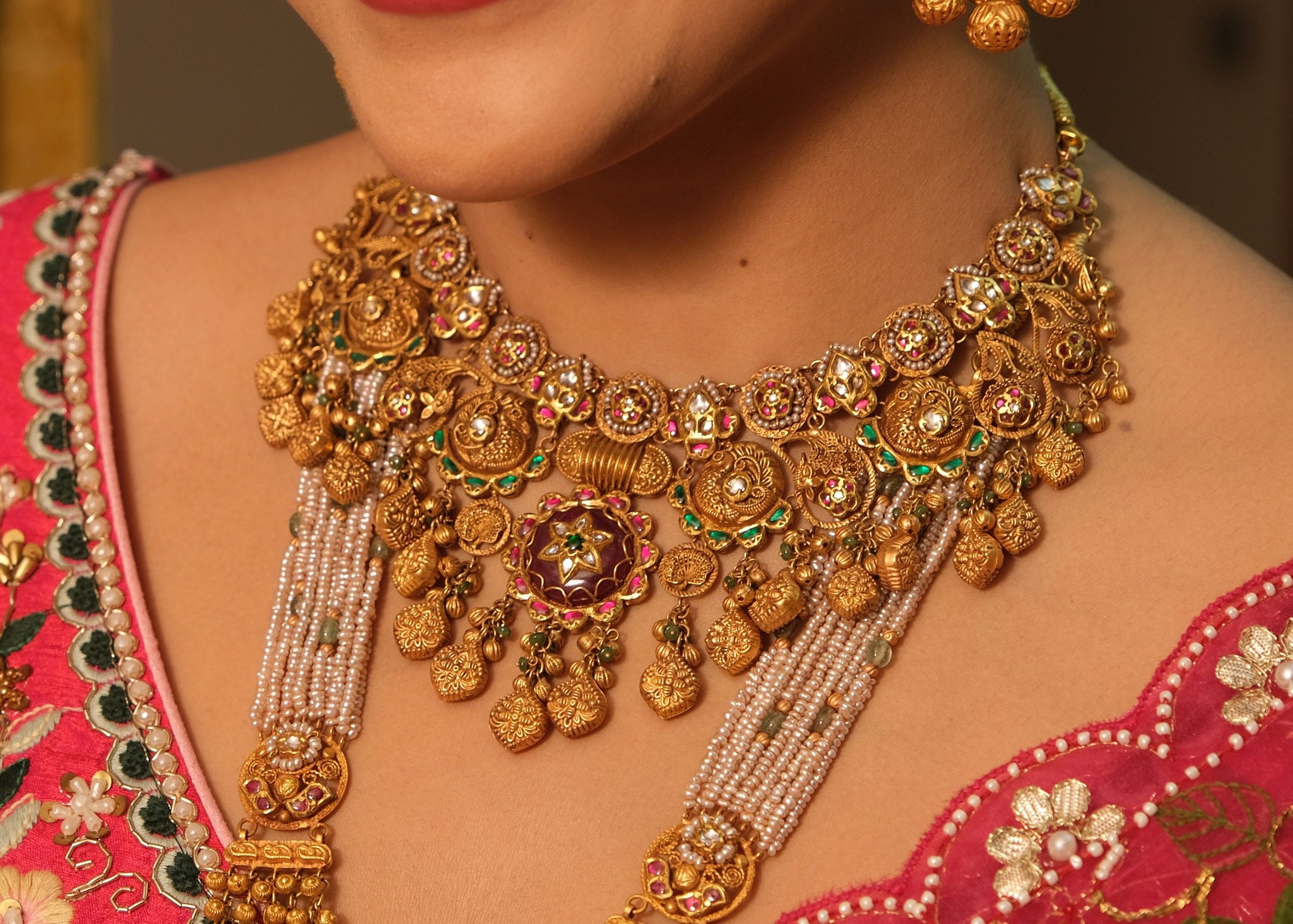
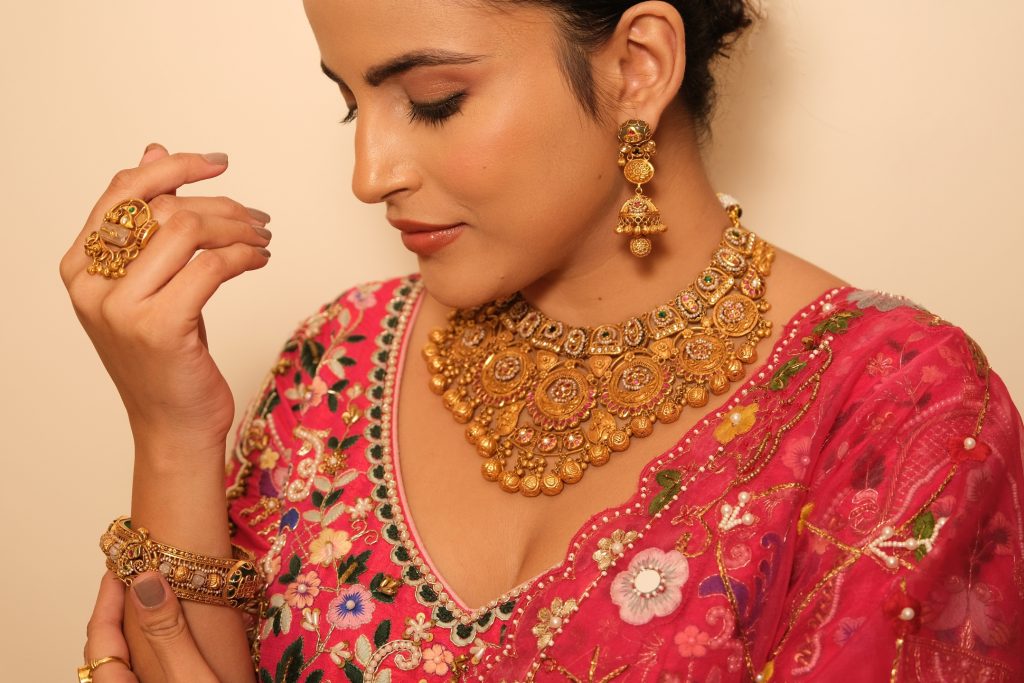
Polki jewellery traces its origins to the royal courts of Rajasthan — the very land where Alankar Jewellers calls home. Flourishing under Mughal patronage, Polki jewellery was the pride of Udaipur’s Mewar royalty. Unlike modern diamonds, Polki stones are uncut, untreated natural diamonds — retaining their raw, organic form. Each stone is unique, slightly cloudy, and radiates an earthy, regal glow that no faceted diamond can replicate.
What makes Polki jewellery truly extraordinary is not just the stone — it is the Jadau technique used to set them. Skilled artisans from Rajasthan and Gujarat spend days embedding uncut diamonds into solid gold frameworks, surrounding them with intricate gold wirework. The back of a Polki piece is finished with Meenakari (vibrant enamel work), making it as exquisite from behind as it is in front.
Each Polki piece is essentially a piece of wearable art — handcrafted, non-replicable, and rich with centuries of artisanal tradition. No two Polki ornaments are ever identical.
Both Polki and Diamonds are 100% real, natural diamonds. The key difference is the process. Polki diamonds are uncut and unpolished, preserving their original earth-mined form, with a soft inner glow. Modern diamonds are precision-cut with up to 58 facets designed to maximise light refraction and sparkle. Polki has a subtle warmth; diamonds have a commanding fire.
Match your personality and occasion to find your perfect jewellery type.
Polki jewellery can be comparably priced to diamond jewellery, but the value driver is different. In Polki, the cost primarily comes from the intricate handcraft (Jadau work, Meenakari) and gold content — not from the Polki stones themselves, which are uncut and uncertified. High-quality certified diamonds, on the other hand, command premium prices for their stone quality alone.
Gold has the best and most liquid resale value in India, followed by certified diamonds (GIA/IGI certified). Polki jewellery, while valuable in artistic and emotional terms, is difficult to resell at an appreciated price as the Polki stones are not graded or certified.
Yellow gold and Polki jewellery are universally flattering on all Indian skin tones, including deeper complexions — the warm, rich tones create a stunning contrast. White gold and platinum diamond settings also look striking on darker skin. Rose gold is particularly beautiful on medium skin tones.