
Alankar Jewellers, Udaipur · 3 min read
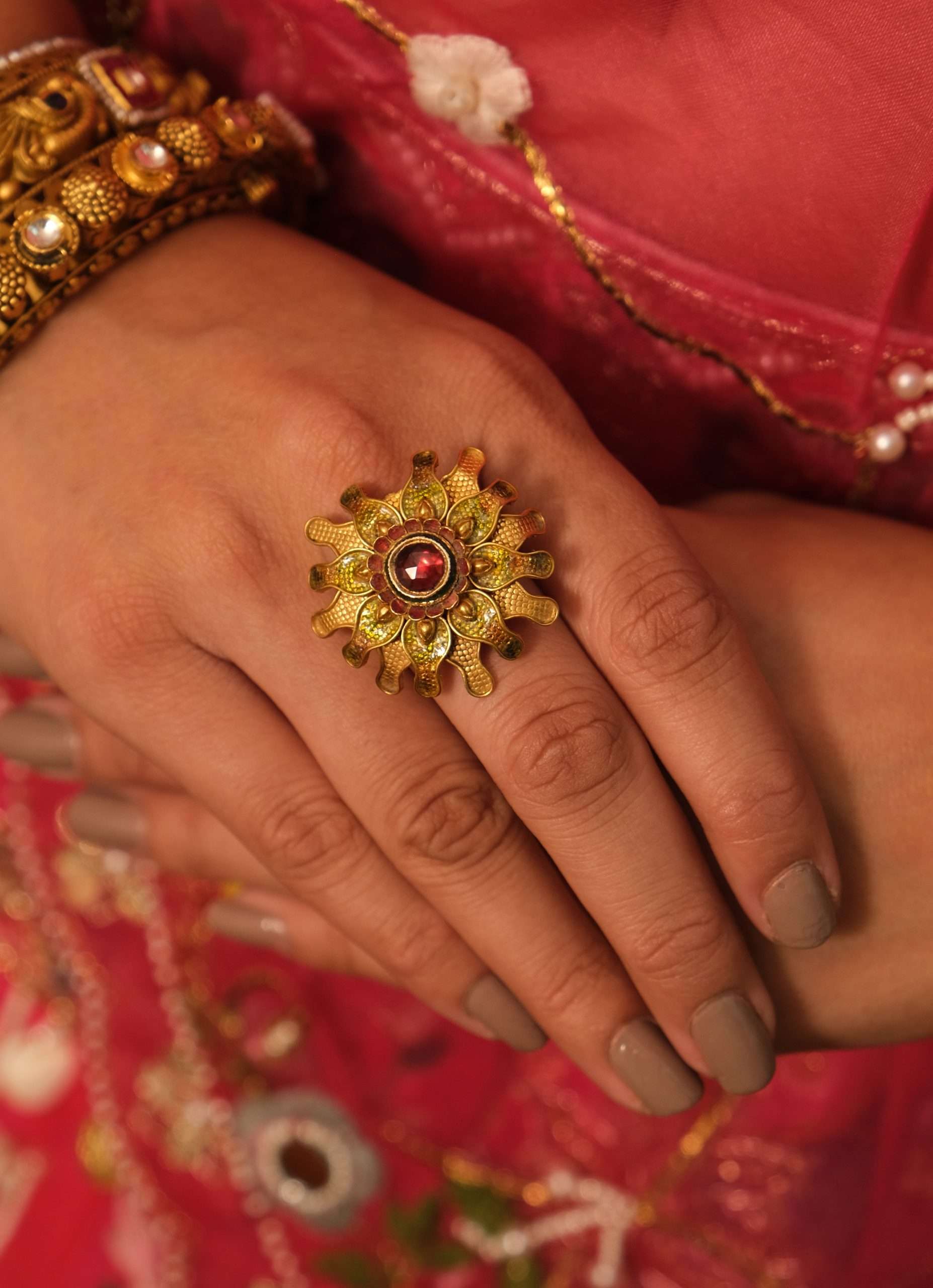
For a long time, good jewellery meant a matching set: necklace, earrings and ring in the same design. Sets still have their place, especially at weddings, but for everyday wear more people now build a look from separate pieces. Two or three rings on one hand. A couple of fine chains at different lengths. Thin bangles mixed with a kada.
Done well, it looks easy and personal. Done badly, it looks like everything in the jewellery box went on at once. The difference is mostly a few simple rules.
Every stack needs a piece that leads. On the hand it might be your engagement ring or a solitaire. Around the neck it is usually a pendant or the slightly heavier chain. Build the rest around it in quieter pieces, so the eye has somewhere to land.
Diamond bands and small solitaires are the easiest place to start. Our diamond jewellery and solitaire collections have pieces that sit well together.
The key is length. Chains that sit too close together tangle and look messy. Leave a gap of roughly five centimetres between each layer, for example a short chain at the collarbone, a second just below it, and a longer one with a pendant.
Bangles are the most natural stack for Indian jewellery. A few thin gold bangles either side of a kada, or a single bracelet worn with a watch, works for office and family functions alike. For weddings, mix plain gold bangles with one polki or kundan kada so the set feels festive without being heavy.
Yes, as long as it looks intentional. The simplest way is to repeat each metal at least twice, so a white-gold ring on one hand is echoed by a white-gold band or chain elsewhere. A single odd piece tends to look like a mistake. If you are unsure, stay in one metal and vary the texture instead.
One of the best things about stacking is that you do not need to buy everything at once. Many people add a ring for an anniversary, a chain for a birthday, a bangle at Diwali. Over a few years it becomes a collection with a story behind each piece.
Whatever you add, buy it properly. Every gold piece should carry the BIS hallmark and a six-digit HUID code, and the bill should show weight, purity, the day’s rate and making charges separately. Our hallmark guide explains what each mark means.
Stacking is easier to judge in a mirror than on a screen. Bring the pieces you already wear when you visit the showroom at 8th Street, Hajareshwar Colony, and our team will help you see what works with them.
Visit Alankar Jewellers, Udaipur
See our gold, diamond, polki and kundan collections in person at our Udaipur jewellery store, 8th Street, Hajareshwar Colony. Open Mon–Sat 11 am – 8:30 pm, Sun 11 am – 7 pm.